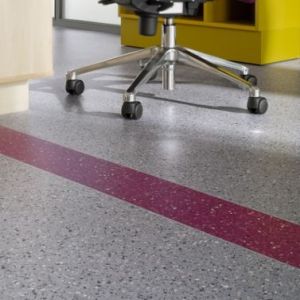
 Linoleum coatings have been around for almost 100 years, but people still believe that vinyl and linoleum are synonymous. The truth is, linoleum and vinyl are two completely different materials. So, what is linoleum, which is mixed so much with vinyl coatings, and how did it come about, let’s examine it together.
Linoleum History
Invented in 1860 by the rubber manufacturer Fredrick Walton, linoleum was used in Victorian homes at that time. Three years after this discovery, Walton purchased a patent for linoleum. Walton’s goal in inventing linoleum was to replace the rubber compound Kamptulicon, a material available at much cheaper prices. Walton’s discovery of linoleum was by examining the surface of oxidized linseed oil formed on the paint.
Containing linseed oil, pigments, pine resin and pine powder, linoleum is produced as a fine mixture, also known as linoleum paste. Linoleum, whose name comes from the Latin “linum” meaning linen and the Latin “oleum” meaning oil, lost its popularity to vinyl coatings in the 1960s.
The linseed oil obtained from flax is first oxidized to produce linoleum paste. The linoleum paste is then mixed with pine resin and wood dust and poured onto boards with a backing made of jute.
In the following years, a Scottish named Michael Nairn developed texture, color and pattern applications on the material. Linoleum, which managed to be the only one on the market until the 1960s, lost its popularity due to the easy-to-apply and relatively inexpensive vinyl coatings that emerged in the 1970s.
A highly durable and eco-friendly material, linoleum adorns your floors, maintaining its appearance for more than 50 years. As a matter of fact, once linoleum is applied to the floor, it becomes much more durable over time; This is because flaxseed oil is oxidized. Despite all this, linoleum has some features that can be seen as disadvantages. The first of these is that it is a little more expensive than vinyl coatings and it is not easy to install.
Linoleum is very useful for areas subject to heavy traffic as it is a durable material. In the oxidation process of linseed oil, not only does the durability of linoleum increase, but its color deepens and becomes richer thanks to the light it receives. On linoleum, scratches are not as obvious as on vinyl. Linoleum, a much more flexible material, is also antistatic and fireproof.
As we mentioned before, this linoleum floor covering price material has a structure that can be decomposed by bacteria, since the substances that make up linoleum are natural. In this way, linoleum does not adversely affect indoor air circulation. In simpler terms, linoleum does not emit PVC into the air like vinyl.
Linoleum is produced in thin sheets or tiles. If you decide to lay this material, the most important thing to consider is to have the application done by a professional. Because the application of linoleum requires expertise. Another point to be considered is that linoleum should be brought to the place where the flooring will be made at least one week before starting the application and it should be waited for it to get used to the environment. In this way, undesirable problems such as expansion or shrinkage during laying can be prevented. Also, considering the fact that water is the main enemy of linoleum, it is very important to dehumidify the subfloor before applying the material.
Maintenance and cleaning recommendations for linoleum coatings
In order to preserve the new and clean appearance of linoleum for a long time, you need to pay attention to a number of points. It is sufficient to sweep the surface of the material at regular intervals and wipe it with a slightly damp cloth. Due to the natural ingredients in linoleum, you should avoid the use of strong alkali-acid detergents such as ammonia.
 Flooring Systems